
How Does Stainless Steel Wiped Film Molecular Distillation Improve Efficiency and Safety?
2026-11-20
How Does Stainless Steel Wiped Film Molecular Distillation Improve Efficiency and Safety?
Stainless steel wiped film molecular distillation is widely used for separating and purifying heat-sensitive materials in chemical, pharmaceutical, and specialty processing industries. By combining thin-film evaporation, mechanical wiping, and high-vacuum operation, this technology helps improve heat transfer while limiting the time materials are exposed to elevated temperatures.
The equipment also offers practical advantages in durability, cleaning, and continuous processing. Understanding its working principle, main components, and operating requirements can help users make better decisions when selecting a distillation system.
1. How Does Stainless Steel Wiped Film Molecular Distillation Work?
Molecular Distillation Under High Vacuum
Molecular distillation operates under very low pressure, which allows substances to evaporate at temperatures lower than their normal boiling points. Separation takes advantage of differences in volatility between components.
More volatile molecules evaporate from the heated liquid surface and travel toward a nearby condenser, while less volatile components remain in the liquid phase. This makes the process suitable for certain high-boiling-point and heat-sensitive materials that may be difficult to separate using conventional distillation.
The actual operating temperature and vacuum level depend on the physical properties of the feed material and the required separation results.
Thin Film Formation and Rapid Evaporation
Inside a wiped film evaporator, rotating wipers distribute the incoming material over the heated inner wall, forming a thin and continuously renewed liquid film.
This arrangement increases the effective heat-transfer area and helps prevent material from remaining in thick layers on the heated surface. Volatile components can evaporate quickly, reducing unnecessary thermal exposure.
Stainless steel construction provides a robust processing surface and supports industrial operation where mechanical strength and material durability are important.
Short-Path Condensation
In short-path molecular distillation systems, the condenser is positioned close to the evaporation surface. This allows vapor molecules to travel a relatively short distance before condensation.
Reducing the vapor travel distance can help limit vapor losses and support efficient collection, particularly when processing substances with low volatility under high-vacuum conditions.
Controlling Residence Time and Processing Capacity
Wiper speed, feed rate, evaporation temperature, and vacuum level all influence the performance of the system.
A suitable wiper speed helps maintain an even liquid film and controls how quickly material moves through the evaporation zone. The feed rate must also be matched to the heating capacity and separation requirements.
Finding the right balance between residence time and processing capacity is important for achieving consistent results without unnecessarily exposing the product to heat.
2. What Are the Main Components of a Stainless Steel Wiped Film System?
A complete wiped film molecular distillation system consists of several components that work together to support evaporation, condensation, and product collection.
Rotating Wipers and Film Distribution
The rotating wiper assembly is responsible for spreading the feed material across the heated surface. Uniform film distribution helps improve heat transfer and reduces the possibility of localized overheating.
Wiper material, geometry, clearance, and rotational speed should be selected according to the feed viscosity and process characteristics.
Condenser and Cooling System
The condenser captures the vapor generated during evaporation and converts it back into liquid for collection.
Its cooling capacity and operating temperature should match the vapor load and the properties of the substances being condensed. A suitable cooling system helps maintain stable condensation conditions and reduces the risk of vapor escaping from the collection area.
Vacuum System
A vacuum system creates and maintains the low-pressure environment required for molecular distillation.
Depending on the process, different vacuum pumps or combinations of pumps may be used. The selection should consider the target pressure, vapor characteristics, system capacity, and compatibility with the process material.
Proper sealing and regular inspection of vacuum connections are also essential for maintaining stable operating conditions.
Temperature Control System
Accurate heating is necessary to achieve the required evaporation rate without exposing the material to excessive temperatures.
Heating jackets or other suitable heating arrangements can provide controlled heat to the evaporator. Temperature sensors and control systems help operators monitor and adjust operating conditions throughout the process.
Stainless Steel Evaporation Chamber
The evaporation chamber provides the main processing surface. Stainless steel, particularly suitable grades such as 316L, is commonly selected for its mechanical strength, durability, and corrosion resistance.
The material grade and surface finish should be determined according to the chemicals being processed, cleaning procedures, and applicable production requirements.
3. Why Is Stainless Steel Used in Molecular Distillation?
Corrosion Resistance and Mechanical Durability
Stainless steel is suitable for many industrial processing environments because it offers good resistance to corrosion and mechanical wear.
Grade 316L is commonly used for product-contact components where improved corrosion resistance is required. However, its compatibility still depends on the specific chemicals, concentrations, temperatures, and exposure conditions involved.
Compared with glass equipment, stainless steel also provides greater mechanical strength, making it suitable for larger systems and demanding industrial operating conditions.
Easier Cleaning and Hygienic Design
Stainless steel has a smooth, non-porous surface that can be designed to reduce material buildup and simplify cleaning.
This is particularly useful in pharmaceutical, nutraceutical, and specialty chemical manufacturing, where equipment cleanliness and contamination control are important.
Depending on the application, polished surfaces, suitable drainage arrangements, and clean-in-place systems can be incorporated. However, compliance with GMP or other industry requirements depends on the complete equipment design, documentation, and manufacturing standards rather than the material alone.
Thermal Stability and Operational Safety
Stainless steel maintains good structural strength across a wide range of operating temperatures. It is therefore suitable for equipment that needs to withstand repeated heating and cooling cycles.
For vacuum applications, the chamber, seals, connections, and other components must be designed to withstand the specified operating pressure. Reliable sealing and appropriate temperature controls help reduce the risk of leakage and unstable operation.
Long-Term Cost Considerations
Although stainless steel systems may require a higher initial investment than some glass alternatives, their durability and suitability for industrial operation can offer long-term value.
Maintenance frequency, production capacity, cleaning requirements, and expected service life should all be considered when comparing equipment costs.
4. How Can You Optimize the Operation of a Wiped Film Distillation System?
Good process control is essential for maintaining efficiency and product quality.
Feed Introduction and Material Distribution
The feed material is introduced into the evaporation chamber under controlled conditions. The rotating wipers then spread it across the heated surface to form a thin liquid film.
Stable feeding helps prevent overloading and supports consistent material distribution. The feed rate should be adjusted according to viscosity, evaporation capacity, and the desired processing result.
Reducing Thermal Degradation
One of the main purposes of molecular distillation is to separate suitable substances while limiting their exposure to high temperatures.
Vacuum operation lowers the required evaporation temperature, while thin-film formation and controlled residence time help reduce prolonged heating.
For heat-sensitive materials, operators should carefully adjust temperature, feed rate, and wiper speed according to the characteristics of the feedstock.
Maintaining Product Purity and Consistency
Separation performance depends on several interacting parameters, including vacuum pressure, evaporation temperature, condenser temperature, and feed composition.
Consistent operating conditions can help improve batch-to-batch or continuous-process stability. Monitoring these parameters also makes it easier to identify changes in equipment performance and adjust the process when necessary.
Balancing Throughput and Separation Performance
Increasing the feed rate does not always improve overall productivity. If the material moves through the evaporation zone too quickly, separation may be incomplete. Excessive feeding can also affect film formation and heat transfer.
The objective is to find a suitable operating range that balances processing capacity with the required separation quality.
The Importance of Vacuum Technology
A stable vacuum environment is essential for effective molecular distillation. Vacuum pump capacity should be selected based on system volume, leakage rate, vapor load, and the required operating pressure.
Regularly checking seals, pipelines, and pump condition can help prevent vacuum fluctuations and maintain reliable operation.
5. How Does Wiped Film Distillation Compare with Rotary Evaporation?
Both wiped film distillation systems and rotary evaporators are used for evaporation and solvent removal, but they are designed for different processing requirements.
Continuous Thin-Film Processing
A rotary evaporator uses a rotating flask to increase the liquid surface area and support evaporation under reduced pressure. It is commonly used in laboratory-scale solvent removal and sample concentration.
A wiped film system uses mechanical wipers to distribute material over a heated evaporation surface. This design is more suitable for continuous processing and can handle certain viscous materials more effectively.
Handling Heat-Sensitive Materials
Both technologies can operate under vacuum to reduce evaporation temperatures. However, wiped film systems are designed to provide a continuously renewed thin film and relatively short residence time.
This can be beneficial when processing materials that are sensitive to prolonged heating, such as selected natural extracts, oils, and specialty chemical compounds.
Processing Viscous Materials
Highly viscous materials can be difficult to process in conventional rotary evaporators because they may not spread or circulate effectively inside the flask.
The mechanical wiping mechanism in a wiped film system helps distribute these materials across the heated surface, making it a practical option for suitable viscous feedstocks.
When Should You Choose a Wiped Film System?
A stainless steel wiped film molecular distillation system may be worth considering when the process involves:
- High-boiling-point substances that require low-pressure separation
- Heat-sensitive materials that need limited thermal exposure
- Viscous liquids that are difficult to process using conventional evaporation equipment
- Continuous production or larger processing volumes
- Applications requiring durable stainless steel construction
The final selection should be based on feed properties, required separation performance, processing capacity, and available operating conditions.
6. Frequently Asked Questions
What Is Wiped Film Molecular Distillation?
Wiped film molecular distillation is a separation process that uses mechanical wiping to spread liquid into a thin film under high-vacuum conditions. Volatile components evaporate from the heated surface and are collected through a nearby condenser.
Why Is Stainless Steel Used for Molecular Distillation Equipment?
Stainless steel is selected for its mechanical strength, durability, and corrosion resistance. Suitable grades such as 316L can be used for many chemical and industrial applications, provided the material is compatible with the process conditions.
How Does Wiped Film Distillation Help Protect Product Quality?
Thin-film formation, vacuum operation, and controlled residence time can reduce unnecessary thermal exposure. These features are useful when processing substances that may degrade under prolonged heating.
What Is the Difference Between Wiped Film Distillation and Rotary Evaporation?
Rotary evaporators use a rotating flask to increase the evaporation surface, while wiped film systems use mechanical wipers to distribute material across a heated surface. Wiped film equipment is generally more suitable for continuous processing and certain viscous materials.
Conclusion
Stainless steel wiped film molecular distillation combines thin-film evaporation, mechanical wiping, and vacuum technology to support efficient separation of suitable heat-sensitive and high-boiling-point materials.
Its stainless steel construction offers durability and practical advantages for industrial applications, while carefully selected wipers, condensers, vacuum pumps, and temperature-control systems help maintain stable operation.
By matching equipment specifications to the material properties and process requirements, manufacturers can achieve a suitable balance between separation performance, product quality, and operational safety.
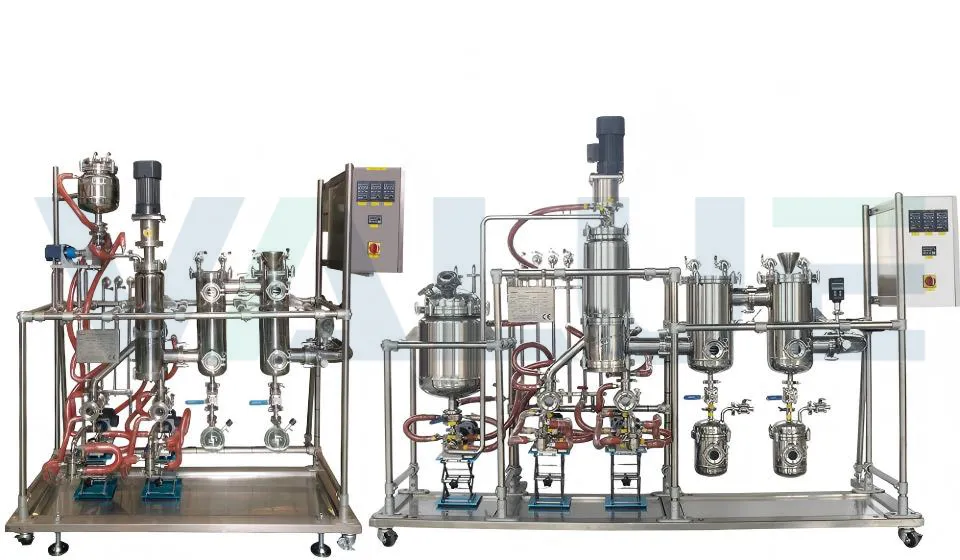
How Does Stainless Steel Wiped Film Molecular Distillation Improve Efficiency and Safety?
Stainless steel wiped film molecular distillation is widely used for separating and purifying heat-sensitive materials in chemical, pharmaceutical, and specialty processing industries. By combining thin-film evaporation, mechanical wiping, and high-vacuum operation, this technology helps improve heat transfer while limiting the time materials are exposed to elevated temperatures.
The equipment also offers practical advantages in durability, cleaning, and continuous processing. Understanding its working principle, main components, and operating requirements can help users make better decisions when selecting a distillation system.
1. How Does Stainless Steel Wiped Film Molecular Distillation Work?
Molecular Distillation Under High Vacuum
Molecular distillation operates under very low pressure, which allows substances to evaporate at temperatures lower than their normal boiling points. Separation takes advantage of differences in volatility between components.
More volatile molecules evaporate from the heated liquid surface and travel toward a nearby condenser, while less volatile components remain in the liquid phase. This makes the process suitable for certain high-boiling-point and heat-sensitive materials that may be difficult to separate using conventional distillation.
The actual operating temperature and vacuum level depend on the physical properties of the feed material and the required separation results.
Thin Film Formation and Rapid Evaporation
Inside a wiped film evaporator, rotating wipers distribute the incoming material over the heated inner wall, forming a thin and continuously renewed liquid film.
This arrangement increases the effective heat-transfer area and helps prevent material from remaining in thick layers on the heated surface. Volatile components can evaporate quickly, reducing unnecessary thermal exposure.
Stainless steel construction provides a robust processing surface and supports industrial operation where mechanical strength and material durability are important.
Short-Path Condensation
In short-path molecular distillation systems, the condenser is positioned close to the evaporation surface. This allows vapor molecules to travel a relatively short distance before condensation.
Reducing the vapor travel distance can help limit vapor losses and support efficient collection, particularly when processing substances with low volatility under high-vacuum conditions.
Controlling Residence Time and Processing Capacity
Wiper speed, feed rate, evaporation temperature, and vacuum level all influence the performance of the system.
A suitable wiper speed helps maintain an even liquid film and controls how quickly material moves through the evaporation zone. The feed rate must also be matched to the heating capacity and separation requirements.
Finding the right balance between residence time and processing capacity is important for achieving consistent results without unnecessarily exposing the product to heat.
2. What Are the Main Components of a Stainless Steel Wiped Film System?
A complete wiped film molecular distillation system consists of several components that work together to support evaporation, condensation, and product collection.
Rotating Wipers and Film Distribution
The rotating wiper assembly is responsible for spreading the feed material across the heated surface. Uniform film distribution helps improve heat transfer and reduces the possibility of localized overheating.
Wiper material, geometry, clearance, and rotational speed should be selected according to the feed viscosity and process characteristics.
Condenser and Cooling System
The condenser captures the vapor generated during evaporation and converts it back into liquid for collection.
Its cooling capacity and operating temperature should match the vapor load and the properties of the substances being condensed. A suitable cooling system helps maintain stable condensation conditions and reduces the risk of vapor escaping from the collection area.
Vacuum System
A vacuum system creates and maintains the low-pressure environment required for molecular distillation.
Depending on the process, different vacuum pumps or combinations of pumps may be used. The selection should consider the target pressure, vapor characteristics, system capacity, and compatibility with the process material.
Proper sealing and regular inspection of vacuum connections are also essential for maintaining stable operating conditions.
Temperature Control System
Accurate heating is necessary to achieve the required evaporation rate without exposing the material to excessive temperatures.
Heating jackets or other suitable heating arrangements can provide controlled heat to the evaporator. Temperature sensors and control systems help operators monitor and adjust operating conditions throughout the process.
Stainless Steel Evaporation Chamber
The evaporation chamber provides the main processing surface. Stainless steel, particularly suitable grades such as 316L, is commonly selected for its mechanical strength, durability, and corrosion resistance.
The material grade and surface finish should be determined according to the chemicals being processed, cleaning procedures, and applicable production requirements.
3. Why Is Stainless Steel Used in Molecular Distillation?
Corrosion Resistance and Mechanical Durability
Stainless steel is suitable for many industrial processing environments because it offers good resistance to corrosion and mechanical wear.
Grade 316L is commonly used for product-contact components where improved corrosion resistance is required. However, its compatibility still depends on the specific chemicals, concentrations, temperatures, and exposure conditions involved.
Compared with glass equipment, stainless steel also provides greater mechanical strength, making it suitable for larger systems and demanding industrial operating conditions.
Easier Cleaning and Hygienic Design
Stainless steel has a smooth, non-porous surface that can be designed to reduce material buildup and simplify cleaning.
This is particularly useful in pharmaceutical, nutraceutical, and specialty chemical manufacturing, where equipment cleanliness and contamination control are important.
Depending on the application, polished surfaces, suitable drainage arrangements, and clean-in-place systems can be incorporated. However, compliance with GMP or other industry requirements depends on the complete equipment design, documentation, and manufacturing standards rather than the material alone.
Thermal Stability and Operational Safety
Stainless steel maintains good structural strength across a wide range of operating temperatures. It is therefore suitable for equipment that needs to withstand repeated heating and cooling cycles.
For vacuum applications, the chamber, seals, connections, and other components must be designed to withstand the specified operating pressure. Reliable sealing and appropriate temperature controls help reduce the risk of leakage and unstable operation.
Long-Term Cost Considerations
Although stainless steel systems may require a higher initial investment than some glass alternatives, their durability and suitability for industrial operation can offer long-term value.
Maintenance frequency, production capacity, cleaning requirements, and expected service life should all be considered when comparing equipment costs.
4. How Can You Optimize the Operation of a Wiped Film Distillation System?
Good process control is essential for maintaining efficiency and product quality.
Feed Introduction and Material Distribution
The feed material is introduced into the evaporation chamber under controlled conditions. The rotating wipers then spread it across the heated surface to form a thin liquid film.
Stable feeding helps prevent overloading and supports consistent material distribution. The feed rate should be adjusted according to viscosity, evaporation capacity, and the desired processing result.
Reducing Thermal Degradation
One of the main purposes of molecular distillation is to separate suitable substances while limiting their exposure to high temperatures.
Vacuum operation lowers the required evaporation temperature, while thin-film formation and controlled residence time help reduce prolonged heating.
For heat-sensitive materials, operators should carefully adjust temperature, feed rate, and wiper speed according to the characteristics of the feedstock.
Maintaining Product Purity and Consistency
Separation performance depends on several interacting parameters, including vacuum pressure, evaporation temperature, condenser temperature, and feed composition.
Consistent operating conditions can help improve batch-to-batch or continuous-process stability. Monitoring these parameters also makes it easier to identify changes in equipment performance and adjust the process when necessary.
Balancing Throughput and Separation Performance
Increasing the feed rate does not always improve overall productivity. If the material moves through the evaporation zone too quickly, separation may be incomplete. Excessive feeding can also affect film formation and heat transfer.
The objective is to find a suitable operating range that balances processing capacity with the required separation quality.
The Importance of Vacuum Technology
A stable vacuum environment is essential for effective molecular distillation. Vacuum pump capacity should be selected based on system volume, leakage rate, vapor load, and the required operating pressure.
Regularly checking seals, pipelines, and pump condition can help prevent vacuum fluctuations and maintain reliable operation.
5. How Does Wiped Film Distillation Compare with Rotary Evaporation?
Both wiped film distillation systems and rotary evaporators are used for evaporation and solvent removal, but they are designed for different processing requirements.
Continuous Thin-Film Processing
A rotary evaporator uses a rotating flask to increase the liquid surface area and support evaporation under reduced pressure. It is commonly used in laboratory-scale solvent removal and sample concentration.
A wiped film system uses mechanical wipers to distribute material over a heated evaporation surface. This design is more suitable for continuous processing and can handle certain viscous materials more effectively.
Handling Heat-Sensitive Materials
Both technologies can operate under vacuum to reduce evaporation temperatures. However, wiped film systems are designed to provide a continuously renewed thin film and relatively short residence time.
This can be beneficial when processing materials that are sensitive to prolonged heating, such as selected natural extracts, oils, and specialty chemical compounds.
Processing Viscous Materials
Highly viscous materials can be difficult to process in conventional rotary evaporators because they may not spread or circulate effectively inside the flask.
The mechanical wiping mechanism in a wiped film system helps distribute these materials across the heated surface, making it a practical option for suitable viscous feedstocks.
When Should You Choose a Wiped Film System?
A stainless steel wiped film molecular distillation system may be worth considering when the process involves:
- High-boiling-point substances that require low-pressure separation
- Heat-sensitive materials that need limited thermal exposure
- Viscous liquids that are difficult to process using conventional evaporation equipment
- Continuous production or larger processing volumes
- Applications requiring durable stainless steel construction
The final selection should be based on feed properties, required separation performance, processing capacity, and available operating conditions.
6. Frequently Asked Questions
What Is Wiped Film Molecular Distillation?
Wiped film molecular distillation is a separation process that uses mechanical wiping to spread liquid into a thin film under high-vacuum conditions. Volatile components evaporate from the heated surface and are collected through a nearby condenser.
Why Is Stainless Steel Used for Molecular Distillation Equipment?
Stainless steel is selected for its mechanical strength, durability, and corrosion resistance. Suitable grades such as 316L can be used for many chemical and industrial applications, provided the material is compatible with the process conditions.
How Does Wiped Film Distillation Help Protect Product Quality?
Thin-film formation, vacuum operation, and controlled residence time can reduce unnecessary thermal exposure. These features are useful when processing substances that may degrade under prolonged heating.
What Is the Difference Between Wiped Film Distillation and Rotary Evaporation?
Rotary evaporators use a rotating flask to increase the evaporation surface, while wiped film systems use mechanical wipers to distribute material across a heated surface. Wiped film equipment is generally more suitable for continuous processing and certain viscous materials.
Conclusion
Stainless steel wiped film molecular distillation combines thin-film evaporation, mechanical wiping, and vacuum technology to support efficient separation of suitable heat-sensitive and high-boiling-point materials.
Its stainless steel construction offers durability and practical advantages for industrial applications, while carefully selected wipers, condensers, vacuum pumps, and temperature-control systems help maintain stable operation.
By matching equipment specifications to the material properties and process requirements, manufacturers can achieve a suitable balance between separation performance, product quality, and operational safety.


