
How Is Vacuum Fractional Distillation Used for Eugenol Extraction from Clove Oil?
2026-07-24
How Is Vacuum Fractional Distillation Used for Eugenol Extraction from Clove Oil?
Eugenol is one of the most commercially significant natural phenolic compounds, widely valued across the flavour, fragrance, pharmaceutical, cosmetic, and dental industries. With the growing demand for high-purity natural ingredients, efficient extraction and purification of eugenol from crude clove oil have become increasingly important for manufacturers.
Crude clove oil, however, contains a complex mixture of volatile compounds that must be separated to isolate concentrated eugenol. Depending on the source—clove buds, leaves, or stems—crude clove oil typically contains 70–90% eugenol, along with other constituents such as β-caryophyllene, eugenyl acetate, humulene, and various sesquiterpenes. To meet the purity standards required for industrial applications, further purification is essential.
Among the available separation technologies, vacuum fractional distillation has emerged as one of the most effective and economical methods for industrial-scale eugenol extraction and clove oil purification. This article explores the principles behind eugenol separation, the advantages of vacuum operation, and the key considerations when selecting fractional distillation equipment for clove oil processing.
What Is Eugenol?
Eugenol (C₁₀H₁₂O₂) is a naturally occurring phenolic compound primarily obtained from clove buds, clove leaves, and clove stems. It is a colourless to pale yellow liquid with a characteristic spicy, clove-like odour.
Key applications of eugenol include:
- Flavour and fragrance manufacturing
- Pharmaceutical intermediates
- Dental anaesthetics and antiseptics
- Personal care products
- Natural preservatives
- Fine chemical synthesis
The commercial value of eugenol increases significantly with purity. While crude clove oil may contain 70–90% eugenol, many industrial applications require purity levels of 98% or higher. This is where advanced purification technologies become essential.
Why Choose Vacuum Fractional Distillation for Clove Oil Purification?
Traditional atmospheric distillation exposes essential oils to elevated temperatures, which can lead to thermal degradation, product discolouration, loss of delicate aroma compounds, and reduced overall product value. These limitations make conventional distillation unsuitable for processing heat-sensitive natural products like clove oil.
Vacuum fractional distillation addresses these challenges by operating under reduced pressure, which lowers the boiling points of all components and allows separation to occur at significantly milder temperatures.
Key Advantages of Vacuum Distillation
Lower Operating Temperatures – By reducing system pressure, the boiling points of eugenol and other components are lowered, minimising thermal stress on the product.
Superior Product Quality – Lower temperatures help preserve the chemical integrity of eugenol, maintaining product colour, odour, and overall quality characteristics.
Enhanced Separation Efficiency – The use of a packed fractionation column increases the number of theoretical plates, enabling more precise separation of eugenol from other compounds.
Reduced Oxidation – Vacuum conditions minimise exposure to oxygen, reducing oxidative degradation and unwanted side reactions.
Research has demonstrated that vacuum distillation can increase eugenol content from approximately 75% in crude oil to 98% or higher. Studies on clove leaf oil rectification using low vacuum pressure (5 and 15 mmHg) have successfully produced fractions with significantly improved eugenol content and quality.
Principles of Eugenol Separation
The objective of eugenol extraction through fractional distillation is to separate eugenol from other volatile and less volatile compounds present in crude clove oil. The process relies on differences in vapour pressure and boiling behaviour under vacuum conditions.
At atmospheric pressure, eugenol has a boiling point of approximately 254°C. However, under vacuum, this boiling point is substantially reduced—for example, eugenol boils at approximately 140°C at 1.6 kPa and 118°C at 670 Pa. This dramatic reduction in boiling temperature is what makes vacuum distillation particularly suitable for heat-sensitive essential oil components.
Typical Process Flow
Feed crude clove oil into the distillation kettle
Apply vacuum to reduce the operating pressure
Gradually heat the mixture to the desired temperature
More volatile fractions vaporise first and are collected separately
The fraction rich in eugenol is collected at the target temperature range
Heavier residues remain in the distillation vessel
A properly designed packed column allows repeated vapour-liquid equilibrium cycles, progressively enriching the eugenol content with each theoretical stage
Equipment Configuration for Eugenol Extraction
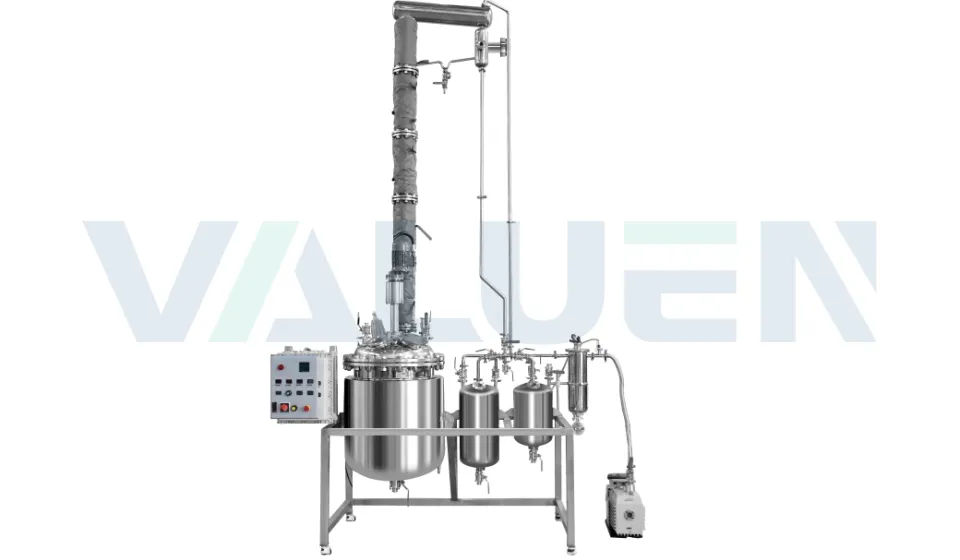
A complete fractional distillation system for eugenol extraction typically consists of the following components:
Stainless Steel Distillation Reactor
Functions as the boiling vessel for crude clove oil. Constructed from SS304 or SS316L stainless steel for excellent corrosion resistance and durability. The fractional distillation equipment's jacketed design allows precise temperature control through circulation of heating or cooling media.
Packed Fractionation Column
The column provides the multiple theoretical stages necessary for high-purity separation. Packing materials—such as stainless steel structured packing, Raschig rings, or wire mesh packing—increase the surface area for vapour-liquid contact. Studies indicate that higher packing height in the distillation column directly correlates with higher eugenol purity.
Condenser System
A shell-and-tube condenser efficiently cools and condenses the vapour fractions. Proper condenser design ensures complete recovery of valuable eugenol fractions.
Vacuum System
The vacuum system—typically comprising liquid ring or dry screw vacuum pumps, with optional vacuum boosters—maintains the reduced pressure necessary for low-temperature operation.
Receiving Vessels
Jacketed stainless steel tanks allow collection of multiple product fractions, enabling separation of light fractions, the eugenol-rich cut, and heavier residues.
Control System
Modern systems integrate PLC-based automation for precise control of temperature, pressure, reflux ratio, and fraction collection, ensuring consistent product quality and reproducible results.
Key Process Parameters for Eugenol Purification
Operating Pressure
Lower operating pressures reduce boiling temperatures and improve separation. Studies on clove oil fractionation have investigated vacuum levels ranging from 5 to 20 inHg, with higher vacuum levels generally producing higher eugenol purity.
Reflux Ratio
The reflux ratio—the proportion of condensed vapour returned to the column versus collected as product—directly influences separation resolution. Higher reflux ratios improve purity at the expense of production rate. Optimisation of this parameter is essential for balancing purity and throughput.
Column Height and Packing
The height of the packed column determines the number of theoretical plates available for separation. Research suggests that a column height of 4 metres operating at 0.2 bar can produce eugenol with 99% purity. The choice of packing material—structured packing versus random packing—also significantly affects separation efficiency and pressure drop.
Temperature Control
Precise temperature management throughout the distillation process is critical. Temperature must be carefully controlled to ensure that eugenol vaporises at the optimal point while lighter fractions and heavier residues are effectively separated.
Conclusion
As demand for natural, high-purity fragrance and flavour ingredients continues to grow, efficient eugenol extraction has become increasingly important for essential oil manufacturers. Vacuum fractional distillation equipment offers a proven, cost-effective, and scalable solution for clove oil purification, enabling producers to achieve eugenol purity levels of 98% or higher while preserving product quality and maximising profitability.
Successful eugenol extraction depends on several interrelated factors: feed composition, vacuum level selection, reflux ratio control, column design, and packing material choice. With properly engineered fractional distillation equipment and optimised process parameters, manufacturers can consistently produce high-purity eugenol for the flavour, fragrance, pharmaceutical, and specialty chemical markets.
Whether for pilot-scale development or full industrial production, vacuum fractional distillation remains one of the most practical and reliable technologies for eugenol recovery and purification from clove oil.
How Is Vacuum Fractional Distillation Used for Eugenol Extraction from Clove Oil?
Eugenol is one of the most commercially significant natural phenolic compounds, widely valued across the flavour, fragrance, pharmaceutical, cosmetic, and dental industries. With the growing demand for high-purity natural ingredients, efficient extraction and purification of eugenol from crude clove oil have become increasingly important for manufacturers.
Crude clove oil, however, contains a complex mixture of volatile compounds that must be separated to isolate concentrated eugenol. Depending on the source—clove buds, leaves, or stems—crude clove oil typically contains 70–90% eugenol, along with other constituents such as β-caryophyllene, eugenyl acetate, humulene, and various sesquiterpenes. To meet the purity standards required for industrial applications, further purification is essential.
Among the available separation technologies, vacuum fractional distillation has emerged as one of the most effective and economical methods for industrial-scale eugenol extraction and clove oil purification. This article explores the principles behind eugenol separation, the advantages of vacuum operation, and the key considerations when selecting fractional distillation equipment for clove oil processing.
What Is Eugenol?
Eugenol (C₁₀H₁₂O₂) is a naturally occurring phenolic compound primarily obtained from clove buds, clove leaves, and clove stems. It is a colourless to pale yellow liquid with a characteristic spicy, clove-like odour.
Key applications of eugenol include:
- Flavour and fragrance manufacturing
- Pharmaceutical intermediates
- Dental anaesthetics and antiseptics
- Personal care products
- Natural preservatives
- Fine chemical synthesis
The commercial value of eugenol increases significantly with purity. While crude clove oil may contain 70–90% eugenol, many industrial applications require purity levels of 98% or higher. This is where advanced purification technologies become essential.
Why Choose Vacuum Fractional Distillation for Clove Oil Purification?
Traditional atmospheric distillation exposes essential oils to elevated temperatures, which can lead to thermal degradation, product discolouration, loss of delicate aroma compounds, and reduced overall product value. These limitations make conventional distillation unsuitable for processing heat-sensitive natural products like clove oil.
Vacuum fractional distillation addresses these challenges by operating under reduced pressure, which lowers the boiling points of all components and allows separation to occur at significantly milder temperatures.
Key Advantages of Vacuum Distillation
Lower Operating Temperatures – By reducing system pressure, the boiling points of eugenol and other components are lowered, minimising thermal stress on the product.
Superior Product Quality – Lower temperatures help preserve the chemical integrity of eugenol, maintaining product colour, odour, and overall quality characteristics.
Enhanced Separation Efficiency – The use of a packed fractionation column increases the number of theoretical plates, enabling more precise separation of eugenol from other compounds.
Reduced Oxidation – Vacuum conditions minimise exposure to oxygen, reducing oxidative degradation and unwanted side reactions.
Research has demonstrated that vacuum distillation can increase eugenol content from approximately 75% in crude oil to 98% or higher. Studies on clove leaf oil rectification using low vacuum pressure (5 and 15 mmHg) have successfully produced fractions with significantly improved eugenol content and quality.
Principles of Eugenol Separation
The objective of eugenol extraction through fractional distillation is to separate eugenol from other volatile and less volatile compounds present in crude clove oil. The process relies on differences in vapour pressure and boiling behaviour under vacuum conditions.
At atmospheric pressure, eugenol has a boiling point of approximately 254°C. However, under vacuum, this boiling point is substantially reduced—for example, eugenol boils at approximately 140°C at 1.6 kPa and 118°C at 670 Pa. This dramatic reduction in boiling temperature is what makes vacuum distillation particularly suitable for heat-sensitive essential oil components.
Typical Process Flow
Feed crude clove oil into the distillation kettle
Apply vacuum to reduce the operating pressure
Gradually heat the mixture to the desired temperature
More volatile fractions vaporise first and are collected separately
The fraction rich in eugenol is collected at the target temperature range
Heavier residues remain in the distillation vessel
A properly designed packed column allows repeated vapour-liquid equilibrium cycles, progressively enriching the eugenol content with each theoretical stage
Equipment Configuration for Eugenol Extraction
A complete fractional distillation system for eugenol extraction typically consists of the following components:
Stainless Steel Distillation Reactor
Functions as the boiling vessel for crude clove oil. Constructed from SS304 or SS316L stainless steel for excellent corrosion resistance and durability. The fractional distillation equipment's jacketed design allows precise temperature control through circulation of heating or cooling media.
Packed Fractionation Column
The column provides the multiple theoretical stages necessary for high-purity separation. Packing materials—such as stainless steel structured packing, Raschig rings, or wire mesh packing—increase the surface area for vapour-liquid contact. Studies indicate that higher packing height in the distillation column directly correlates with higher eugenol purity.
Condenser System
A shell-and-tube condenser efficiently cools and condenses the vapour fractions. Proper condenser design ensures complete recovery of valuable eugenol fractions.
Vacuum System
The vacuum system—typically comprising liquid ring or dry screw vacuum pumps, with optional vacuum boosters—maintains the reduced pressure necessary for low-temperature operation.
Receiving Vessels
Jacketed stainless steel tanks allow collection of multiple product fractions, enabling separation of light fractions, the eugenol-rich cut, and heavier residues.
Control System
Modern systems integrate PLC-based automation for precise control of temperature, pressure, reflux ratio, and fraction collection, ensuring consistent product quality and reproducible results.
Key Process Parameters for Eugenol Purification
Operating Pressure
Lower operating pressures reduce boiling temperatures and improve separation. Studies on clove oil fractionation have investigated vacuum levels ranging from 5 to 20 inHg, with higher vacuum levels generally producing higher eugenol purity.
Reflux Ratio
The reflux ratio—the proportion of condensed vapour returned to the column versus collected as product—directly influences separation resolution. Higher reflux ratios improve purity at the expense of production rate. Optimisation of this parameter is essential for balancing purity and throughput.
Column Height and Packing
The height of the packed column determines the number of theoretical plates available for separation. Research suggests that a column height of 4 metres operating at 0.2 bar can produce eugenol with 99% purity. The choice of packing material—structured packing versus random packing—also significantly affects separation efficiency and pressure drop.
Temperature Control
Precise temperature management throughout the distillation process is critical. Temperature must be carefully controlled to ensure that eugenol vaporises at the optimal point while lighter fractions and heavier residues are effectively separated.
Conclusion
As demand for natural, high-purity fragrance and flavour ingredients continues to grow, efficient eugenol extraction has become increasingly important for essential oil manufacturers. Vacuum fractional distillation equipment offers a proven, cost-effective, and scalable solution for clove oil purification, enabling producers to achieve eugenol purity levels of 98% or higher while preserving product quality and maximising profitability.
Successful eugenol extraction depends on several interrelated factors: feed composition, vacuum level selection, reflux ratio control, column design, and packing material choice. With properly engineered fractional distillation equipment and optimised process parameters, manufacturers can consistently produce high-purity eugenol for the flavour, fragrance, pharmaceutical, and specialty chemical markets.
Whether for pilot-scale development or full industrial production, vacuum fractional distillation remains one of the most practical and reliable technologies for eugenol recovery and purification from clove oil.


